|
 |
|
|
|
|
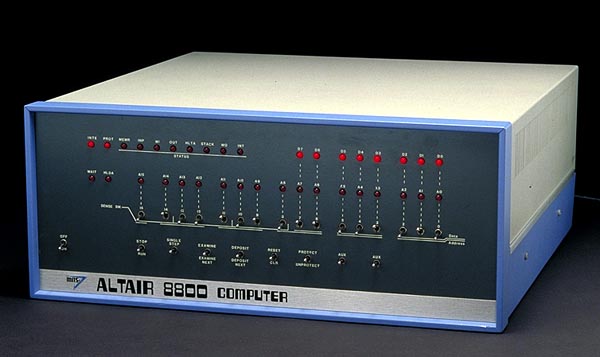
Smithsonian Image 88-19284 |
NMAH Object 1987.0066.01 Not long after Intel introduced its 8080 chip, a small firm in Albuquerque, New Mexico, named MITS (Micro Instrumentation and Telemetry Systems) announced a computer kit called the Altair, which met the social as well as technical requirements for a small personal computer. MITS succeeded where other, more established firm had failed, and it was their machine that inaugurated the personal computer age. MITS got its start in computing in 1971, when it introduced an electronic calculator kit. Several thousand sold before 1974, when the sharp reduction in calculator prices drove the company out of that market. H. Edward Roberts, the Florida-born former U.S., Air Force officer who headed MITS, decided to design a small, affordable computer around the Intel 8080. His daughter named the new machine after the star Altair. It was the first microcomputer to sell in large numbers. In January, 1975, an photograph of the Altair appeared on the cover of the magazine Popular Electronics. The caption read "World's First Minicomptuer Kit to Rival Commercial Models." According to the magazine, the machine sold as a kit for $395 and assembled for $498. Roberts had hoped to break even by selling 200 Altairs. Within three months he had a backlog of 4000 orders. The kit offered by MITS represented the minimum configuration of circuits that one could legitimately call a "computer." It had little internal and no external memory, no printer, and no keyboard or other input device. An Altair fitted out with those items might cost $4000--the equivalent to the cheapest PDP-8 minicomputer, a reliable and established performer. Most purchasers found the kit was difficult to assemble, unless they had experience with digital electronics and a workbench fitted out with sophisticated test equipment. And even if one assembled the kit correctly it was sometimes difficult to get the Altair to operate reliably. |